December 1, 2025
It’s hard to believe it has only been three years.
On November 30, 2022, there was no global countdown. No keynote delivered by a tech CEO in a turtleneck. No cinematic launch video with futuristic background music. There was just a quiet tweet from OpenAI announcing a “research preview” called ChatGPT.
I remember sitting at my laptop that first week, not quite sure what I was about to witness. Like many of you, I opened with a deliberately ridiculous prompt – something about a sea shanty inspired by complex spreadsheets -expecting it to fail spectacularly. Instead, I watched that grey cursor blink once… and then stream out something so unexpectedly clever that I actually laughed out loud.
That was the click felt around the world.
The Evolution of a Species (2022–2025)
To understand where we are today, it’s worth looking back at how rapidly the “biology” of this technology has evolved. In just three short years, ChatGPT transformed from a text-bound brain in a jar into a fully sensing digital partner.
1. The Text-Only Era (2022)
“The Brain in a Box”
When ChatGPT launched, running on GPT-3.5, it was brilliant but painfully limited. It was blind, deaf, and mute – a purely textual intelligence. Describe your broken sink? You had to explain the leak in excruciating detail because it couldn’t see. It was a powerful linguistic tool, but it had no access to the physical world around us.

2. The Awakening of Senses (2023–2024)
“Eyes, Ears, and a Voice”
Late 2023 hinted at change, but May 2024 marked the true leap. GPT-4o (“Omni”) erased the distinction between “AI interaction” and “conversation.”
Suddenly, latency disappeared. The model could hear tone. It could see emotion. It could respond while you interrupted it. We snapped photos of our fridges for recipes, asked it questions on our walks, and started treating it less like a search box and more like a companion in dialogue.
It stopped waiting for prompts.
It started participating.
3. The Agentic Era (2025)
“The Active Partner”
This year brought the most dramatic shift yet: AIs that don’t just answer – they act. With real-time video analysis, reasoning engines, and contextual memory, ChatGPT stepped out of the realm of tool and into the realm of partner.
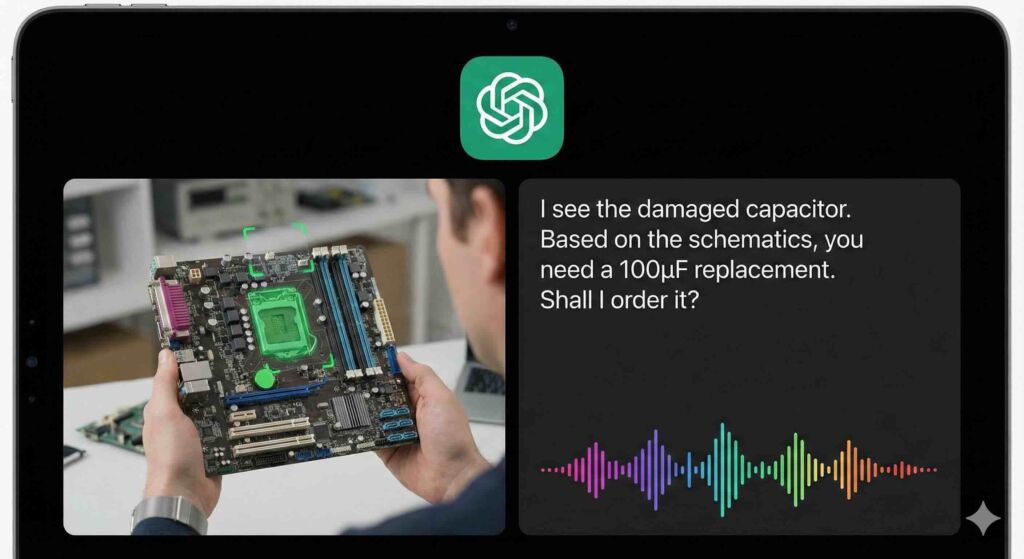
2025: A multimodal partner that can see, hear, and reason in real-time.
📸 Pic was generated with my helpful assistant credit Gemini Pro 3
The Human Element: Growing Pains
At The AI Assembly™, we focus on the human experience, not just the technical increments – and the last three years have put us all through emotional whiplash.
-
2022: The honeymoon phase – awe, experimentation, delight.
-
2023: The fear phase – “Will this replace me?”
-
2024: The frustration phase – the rise of low-effort AI content flooding our feeds.
Now, in late 2025, something has shifted. Panic has settled into pragmatism. ChatGPT has grown to 800 million weekly active users, but what people are doing with it has fundamentally changed.
Then: 80% of prompts were for code, content, and productivity.
Now: Over 70% of conversations are personal – learning, reflection, creativity, and advice.
We’re starting to understand that AI isn’t here to displace human ingenuity. It’s here to multiply it.
Looking Ahead: The Terrible Threes?
ChatGPT is only three years old. In human terms, it’s just out of nappies – walking confidently, talking constantly, occasionally throwing tantrums.
As we look toward 2028, our collective responsibility remains the same:
We must be the adults in the room.
We need to guide this technology toward outcomes that centre humanity – authenticity, connection, and clarity – rather than letting the technology set the terms for us.
Happy birthday, ChatGPT.
Three years in, and the journey has only just begun.
✨ Crafted by me as a human, polished by Gemini. I use AI to sharpen my writing, but the opinions are 100% mine.