By Karrina Mountfort, Founder — The AI Assembly®
If something looks real, sounds real and feels real, most of us naturally assume it is.
For a long time, that was a pretty safe assumption.
But we’re now at a point where AI can create very realistic images, voices and videos in seconds. That doesn’t mean the world has fallen apart. It just means we need to adjust slightly.
In an AI-powered world, how real something looks isn’t always enough to confirm that it’s real.
For years we’ve relied on visual proof.
“If there’s footage, it must have happened.”
“If there’s a photo, it must be true.”
Now, realism is easier to manufacture.
So the skill we need is discernment.
Here are a few practical ways to think about it.
AI doesn’t “know” things — it predicts patterns
AI systems generate responses based on what is statistically likely. They don’t understand context the way humans do.
That’s why they can sound incredibly confident — and still be wrong.
If you ask the same question in a slightly different way and get a different answer, that’s a sign to slow down and check.
Strong emotion is a cue to pause
If something online makes you instantly angry, scared or triumphant — that’s your signal.
Not that it’s fake.
But that you should take a breath before reacting or sharing.
Emotion spreads content quickly. Thoughtfulness slows it down.
And slowing down is often what protects us.
When it matters, verify beyond the original source
If you receive a strange message from your “boss” asking for money — call them directly.
If you see breaking news — check more than one reputable outlet.
If something feels off — trust that instinct and look a little deeper.
AI can copy tone and appearance.
It can’t replicate real relationships or lived experience.
There’s a difference between being skeptical and being cynical.
Cynical says: “Nothing is real anymore.”
Skeptical says: “I’ll take a moment to check.”
We don’t need to become distrustful.
We just need to become a little more thoughtful.
AI literacy isn’t about coding or understanding algorithms.
It’s about everyday judgement.
It’s about slowing down.
Asking better questions.
And checking before we amplify.
AI literacy isn’t a tech skill.
It’s a life skill.
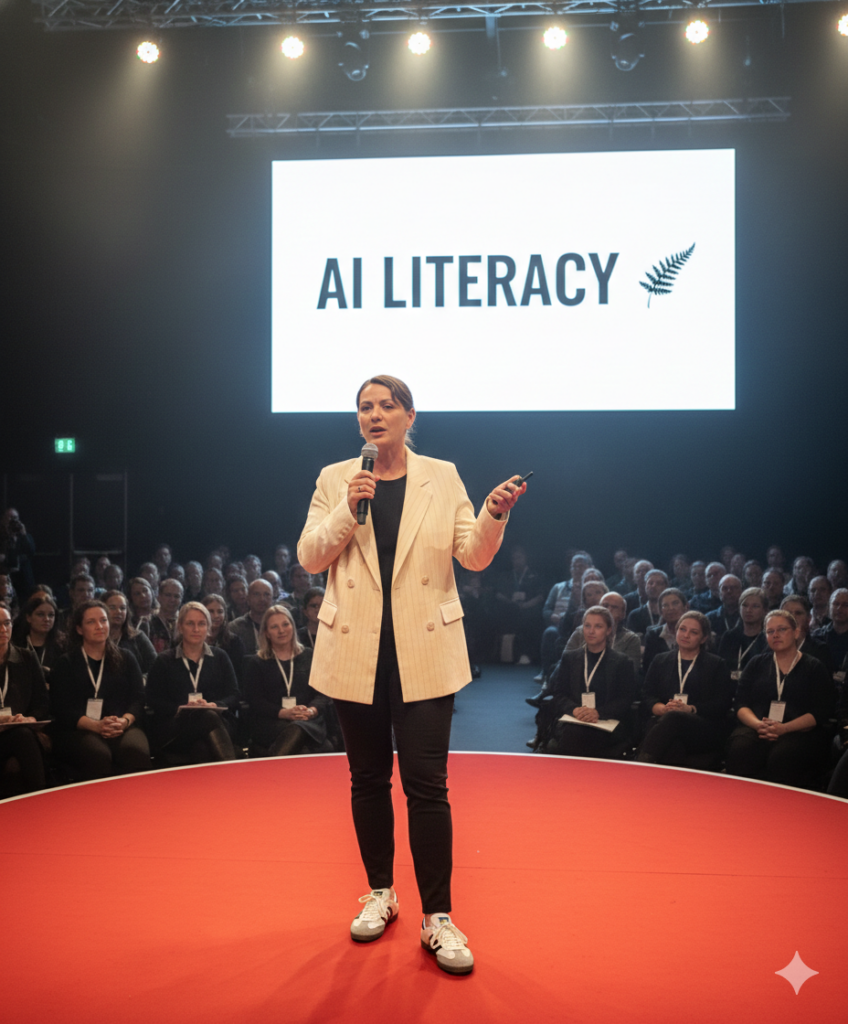
Image made with prompt by Gemini in Google
About Karrina

About the Author
Karrina Mountfort is the Founder of The AI Assembly® and creator of the AI The Right Way® methodology — a human-centred framework building AI literacy and capability across Aotearoa New Zealand.
Alongside her national literacy work, Karrina leads practical AI implementation through her WebBased AI practice, helping small and medium-sized businesses integrate cloud-based AI tools into everyday operations.
Her strength lies in clarity and systems thinking. She works with organisations to ensure AI adoption is intentional and sustainable — built on strong SOP foundations, aligned workflows, privacy awareness, and human oversight.
Karrina supports teams to move from experimentation to structured AI-assisted workflows and automation — reducing siloed systems while increasing productivity.
Through education, implementation and community initiatives including HerAIStory, she is committed to ensuring AI is integrated wisely, not just quickly.
AI literacy isn’t a tech skill.
It’s a life skill.
—
Karrina Mountfort
Founder, The AI Assembly®
Karrina's latest posts
The New Rules of Reality: A Human Guide to Living in an AI-Powered World
Home / By Karrina Mountfort, Founder — The AI Assembly® If something looks real, sounds real and feels real, most of us naturally assume it is. For a long time, that was a pretty safe assumption. But we’re now at a point where AI can create very realistic images, voices
How to Build the Future With Your People, Not At Them
Home / In my opinion by Karrina Mountfort December 2, 2025 Leaders everywhere can feel it — the future of work is shifting underneath us.AI is part of that shift, but the real transformation is happening with people. Inside NZ organisations, I see the same pattern: Leaders want clarity, safety
The Toddler That Changed the World: Reflections on ChatGPT at Three
Home / In my opinion by Karrina Mountfort December 1, 2025 It’s hard to believe it has only been three years. On November 30, 2022, there was no global countdown. No keynote delivered by a tech CEO in a turtleneck. No cinematic launch video with futuristic background music. There was